Executive Summary:
- U.S. stocks gained 1.41% in the third quarter, although returns varied by company size. Large-cap stocks rose 1.80%, while small-cap stocks fell -7.23%.
- International markets posted mixed results. Developed markets gained 0.89%, while emerging markets declined -0.37%.
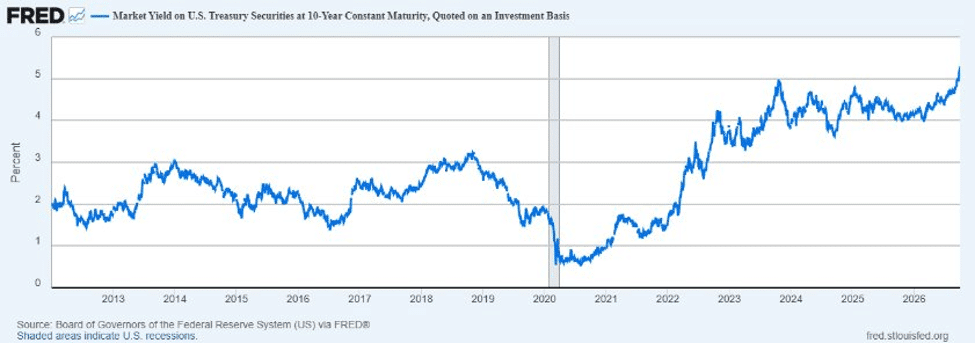
- The 10-year U.S. Treasury yield climbed to 5.29% by the end of September, its highest quarter-end since 2007.
- The Federal Reserve raised its benchmark interest rate by a 0.25 percentage point in September, reversing its recent rate-cutting direction.
In the latter half of the 20th century, philosopher John Rawls introduced the idea of the “veil of ignorance.”
In his thought experiment, Rawls challenged people to reflect on the type of society they’d want if they didn’t know what position they would hold within it. Financial planning, by contrast, happens under a veil of uncertainty rather than ignorance. In this context, we are aware of the existing risks, but we are uncertain of their magnitude and rate or occurrence. Ignorance, on the other hand, is being oblivious to the risks altogether. If your financial advisor is uninformed of a risk to your financial well-being, you may need a new advisor.
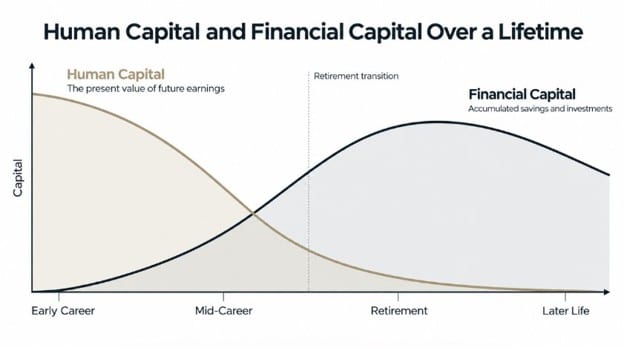
One of the best ways to understand the risks veiled by uncertainty is to look at a map.
Figure 1 shows the gradual shift from human capital to financial capital throughout our lifetime.
Now, what risks will we encounter on this journey? I’d define “risk” as anything that either impedes the accumulation of financial capital or rapidly depletes it.
From this point of view, the fluctuations we see in a diversified portfolio are often akin to turbulence on an airplane: uncomfortable but manageable when we’ve prepared for the journey. The real risks to our financial journey are the mistakes we make and the unexpected life events we’re unprepared to navigate.
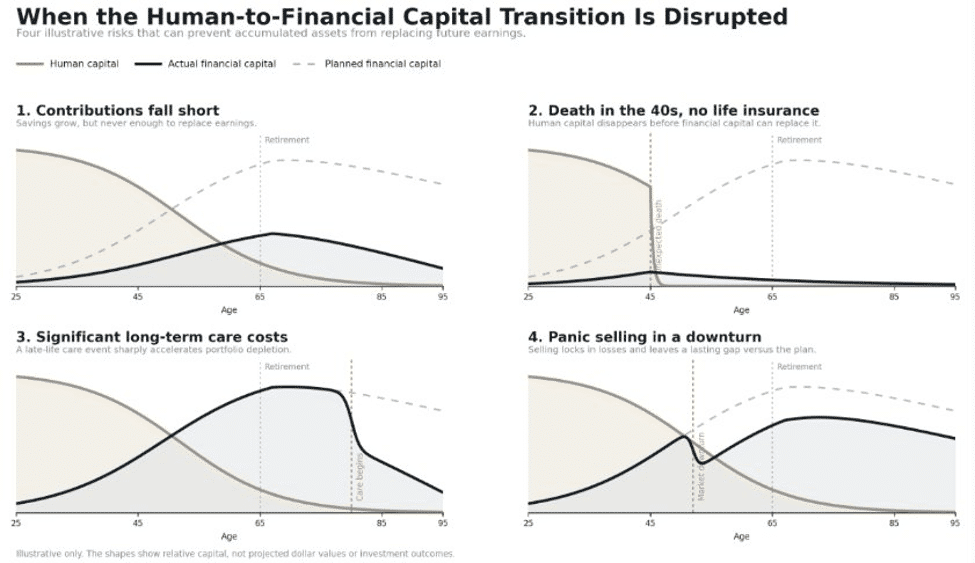
Let’s look at Figure 2 to review some of the errors and unfortunate events that can harm our financial plan and fellow passengers.
For those planning for retirement
One risk is failing to contribute enough to our investment accounts to achieve or maintain the quality of life we envision once we leave the workforce. Another is passing away before saving enough to provide for our family.
For those already retired, the risks may look like unexpected long-term care costs or panic selling during a market downturn.
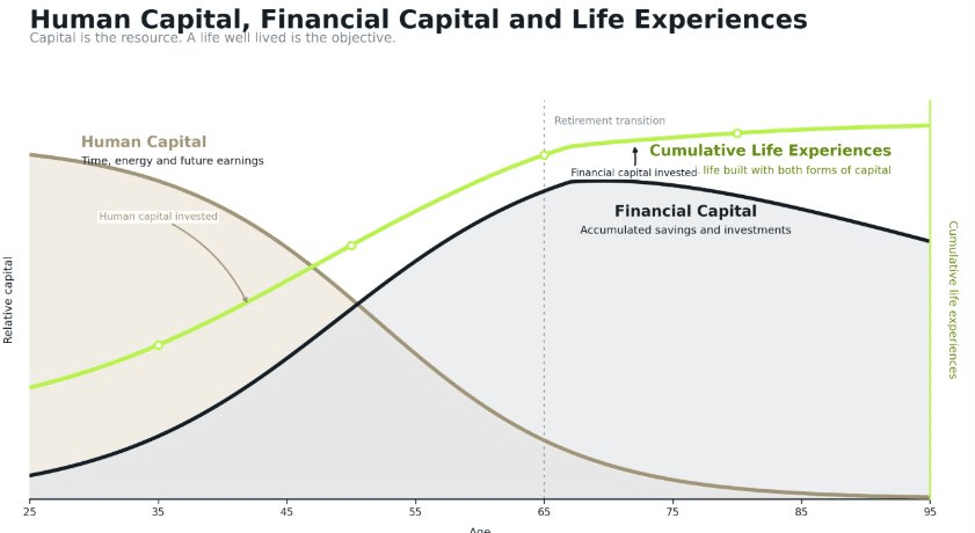
So far, I’ve written about the veil of uncertainty as a risk that needs to be managed. However, I also think the veil can serve as a motivator in our financial journey. As Figure 3 depicts, knowing there is risk beyond the turbulence in our portfolios should encourage us to use our human and financial capital across our lifetime to invest in the life experiences that bring us meaning. It dares us to ask whether we’re spending our working years accumulating things instead of memories. Or in retirement, refusing to spend our financial capital on the trips that bring us joy. Like the White Queen in Through the Looking-Glass, is it always jam tomorrow and never today?
When reading through a quarterly market review, you may focus on how your portfolio fluctuates with world events and Treasury yields. However, I hope what these various maps illustrate is that some of life’s greatest risks have little to do with market performance at all. They’re the financial uncertainties we cannot predict and the meaningful experiences we continually postpone.
A thoughtful financial plan prepares us for the former while giving us the freedom to pursue the latter. Ultimately, it should encourage us to live boldly and experience what truly matters.
Stocks Hold Steady as Interest Rates Rise Above 5%
At first glance, the stock market’s third-quarter performance appeared uneventful.
The S&P 500 gained roughly 2%, a slowdown from the second quarter. Technology and AI-related stocks had mixed results as investors favored companies putting AI investments to work: Microsoft gained approximately 38%, supported by strong cloud growth. Meta rose 29% as enthusiasm for its AI products increased.
Meanwhile, Western Digital and South Korean memory-chip manufacturer SK Hynix each declined more than 20% after significant earlier gains, suggesting investors are becoming more selective about which companies will benefit from continued AI spending.
International markets also delivered mixed results. Developed international stocks, measured by the MSCI EAFE Index, gained 0.8%. Emerging markets declined 0.4%, pressured by pullbacks in some AI-related stocks, particularly in South Korea.
U.S. stocks finished the quarter higher, supported by strong earnings from many of the largest technology companies. The bigger story, however, was outside the stock market.
Oil prices surged, inflation remained elevated, and Treasury yields climbed as investors reassessed the outlook for inflation and economic growth. By the end of September, the 10-year U.S. Treasury yield had reached 5.29%, its highest level in nearly two decades.
The 10-year U.S. Treasury bond’s yield rising above 5% represents a significant shift for bond investors. For years after the Great Financial Crisis, high-quality bonds offered little income. That began to change when interest rates rose in 2022, making bonds more attractive to investors seeking income.
20 Years of the 10-Year U.S. Treasury Yield (2006–2026)
After spending much of the past two decades at historically low levels, the 10-year Treasury yield climbed above 5% by the end of September 2026, illustrating how dramatically the fixed-income environment has changed.
Why Did Treasury Yields Rise So Much?
Treasury yields rose during the third quarter as resilient economic growth, substantial federal borrowing, and lingering inflation concerns led investors to demand higher returns on longer-term government bonds. The economy remained stronger than many had expected, reducing expectations for lower interest rates. Meanwhile, large federal deficits required the Treasury to continue issuing significant amounts of debt, increasing the supply of bonds investors needed to absorb.
Inflation added another complication. Brent crude rose roughly 40% during the quarter as the military conflict in the Middle East disrupted global energy markets. Higher energy prices raised concerns that inflation could remain elevated longer than previously expected, adding uncertainty about the direction of future interest rates.
The 10-year Treasury yield is determined by the bond market rather than directly by the Federal Reserve. As investors reassessed these economic conditions and demanded higher returns for lending over a longer period, Treasury bond prices fell and yields increased.
Why Rising Yields Hurt Bonds
One of the more mystifying aspects of bond investing is that prices and yields move in opposite directions. Imagine owning a bond that pays a fixed amount of interest each year. If newer bonds offer higher returns, investors are less likely to pay as much for your older bond. Its market price must fall enough to make its return competitive.
That is what happened during the third quarter. As Treasury yields climbed, the market value of existing bonds fell. Longer-term bonds were hit harder because their prices tend to be more sensitive to interest-rate changes.
For investors reviewing their statements, this can be frustrating. Bonds are often viewed as the steadier part of a portfolio, yet rising interest rates can still cause short-term losses.
The Other Side of Higher Yields
Higher rates reduce the value of bonds already owned but increase the income available on bonds purchased today.
For years after the Great Financial Crisis, bonds offered little income in return for the interest-rate and inflation risk investors took on. That changed when the Fed began raising interest rates in 2022. With Treasury yields around 5%, bonds can provide meaningful income again while helping preserve capital and reducing some of the volatility associated with stocks.
That, however, does not mean a 5% Treasury yield replaces stocks.
When yields are this high, investors may reasonably ask: If I can earn around 5% from a Treasury, why would I take the additional risk of owning stocks? The answer comes down to the role each investment is designed to play.
A bond offers scheduled interest payments and the return of principal at maturity, assuming the issuer meets its obligations. Stocks represent ownership in businesses whose earnings and value can grow over time. That growth is uncertain and more volatile, but it is also why stocks play an important role in portfolios built for long-term growth.
Expectations and Reality
The third quarter was another reminder that markets rarely follow the path investors expect. At the start of the year, the focus was on lower interest rates and whether U.S. stock valuations were justified. Instead, the 10-year Treasury yield moved above 5% while stocks stayed positive on strong corporate earnings.
Higher yields have made fixed-income investments more attractive, while stocks continue to offer long-term growth. The goal is not to predict which will outperform next quarter, but to build a portfolio that can weather changing market conditions.
- Quarterly Market Review – Q3 2026
- Quarterly Market Review – Q2 2026
- Don’t Leave College Tax Credits on the Table
- SpaceX’s Public Market Debut: Opportunity, Expectations, and What Investors Should Consider
- Why Everyone Should Have a Power of Attorney