
When you work for yourself, no one hands you a retirement plan. There is no HR department, automatic employer match or default savings system to rely on. You have to build it yourself.
For many self-employed business owners, the decision comes down to a SEP (Simplified Employee Pension) IRA or a Solo 401(k). Both can create tax deductions and help turn business income into long-term wealth, but they work differently.
I tend to view the SEP IRA as a good starting point. It’s simple, flexible, and can often be established after the calendar year has ended. The Solo 401(k) requires more setup and administration; but as a business becomes more established and the owner wants to save more intentionally, the additional flexibility may make it the logical next step.
The SEP IRA: Simple and Flexible
A SEP IRA is funded through employer contributions. For 2026, you can contribute up to 25% of your eligible compensation or $72,000, whichever amount is lower. For sole proprietors, the calculation is different because it is based on adjusted net earnings from self-employment.
The biggest advantage of a SEP IRA is simplicity. The business can contribute more after a strong year, less after a slower year, or potentially nothing at all. Generally, a SEP can be established and funded by the business’s tax-filing deadline, including extensions. This can make it especially useful when the year has already ended and the owner is looking back at a profitable year and deciding how much of that income to direct toward retirement.
One thing to note is that the SEP provides the owner with just one main contribution lever: the employer contribution. There are no employee salary deferrals or 401(k) catch-up contributions. Depending on the owner’s income and goals, this may limit how much can be saved.
The Solo 401(k): More Contribution Flexibility
A Solo 401(k) is generally designed for a business with no eligible employees other than the owner and possibly the owner’s spouse (if they also work in the business and receive eligible compensation). Each participating owner or spouse may be able to make employee contributions, while the business may also make employer contributions based on eligible compensation.
For 2026, the employee deferral limit is $24,500, with additional catch-up contributions available for eligible owners age 50 or older. This is where the Solo 401(k) can offer a major advantage.
Assume an S corporation owner earns $100,000 in W-2 wages. With a SEP IRA, the simplified maximum contribution would generally be $25,000. With a Solo 401(k), the owner may be able to make a $24,500 employee deferral and receive a $25,000 employer contribution, for a total of $49,500.
One important limitation is that the employee deferral limit generally applies across 401(k) plans. If the owner also participates in a 401(k) through another employer, they do not receive a second $24,500 employee deferral limit for the Solo 401(k). That does not necessarily eliminate the value of the Solo 401(k), since an employer contribution may still provide additional savings capacity.
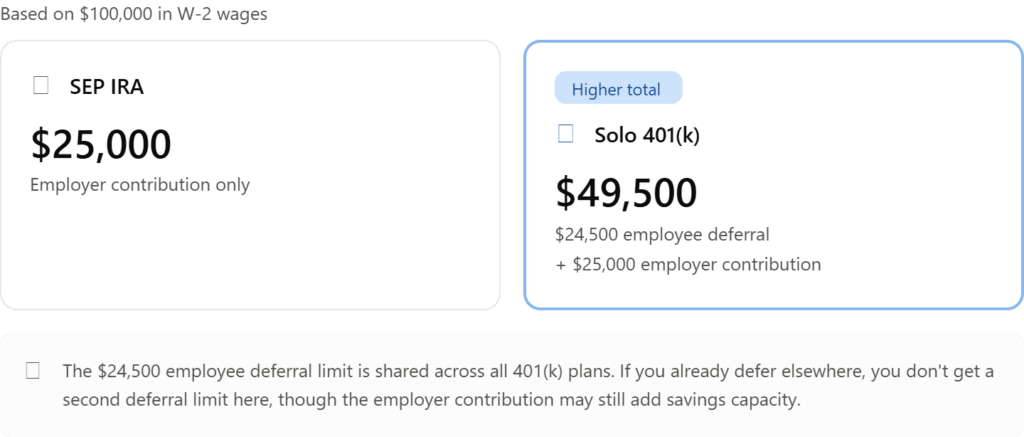 In the example above, the employer contribution did not increase. The Solo 401(k) simply added another contribution layer. This can allow the owner to save substantially more without dramatically increasing W-2 compensation.
Depending on the provider, plan design, and applicable tax rules, a Solo 401(k) may also offer Roth contributions, catch-up contributions, and participant loans. Not every owner needs those features, but the plan provides more options.
A Special Consideration for S Corporation Owners
The Solo 401(k) can become especially relevant when an owner is already operating through an S corporation and running payroll. For an S corporation owner, retirement plan contributions are based on W-2 compensation. Shareholder distributions do not count as compensation for retirement plan purposes.
Employee deferrals also need to be properly elected and coordinated with payroll. An owner generally cannot wait until after the year ends and retroactively turn distributions or previously paid wages into 401(k) contributions. That generally requires more work than a SEP IRA.
However, an established S corporation is already processing payroll, determining reasonable compensation and working with an accountant or payroll provider. At that point, adding a Solo 401(k) may be a reasonable next step rather than a major complication.
More Flexibility Means More Administration
A Solo 401(k) is still a 401(k). It requires a formal plan document, ongoing administration, and additional attention. Once plan assets exceed $250,000, an annual Form 5500-EZ filing is generally required.
The question is whether the additional flexibility is worth the added responsibility. For an owner contributing only a few thousand dollars per year, it may not be. For an owner trying to save $30,000, $40,000 or more, it often deserves a closer look.
Employees Can Change the Decision
The word “solo” matters. A Solo 401(k) generally works only while the business has no eligible common-law employees.
A SEP IRA can include employees, but eligible employees generally must receive the same contribution percentage as the owner. If the owner contributes 20% of compensation for themselves, the business may also need to contribute 20% for each eligible employee.
Business owners should consider both their current situation and future hiring plans when choosing a retirement plan.
SEP IRA or Solo 401(k): Which Plan Makes Sense?
A SEP IRA may make sense when:
- You want simplicity
- Your income is inconsistent
- The calendar year has already ended
- The employer contribution allows you to save enough and
- You do not need additional plan features.
A Solo 401(k) may make sense when you have an established owner-only business and want to combine employee and employer contributions. It may also be worth considering if you want Roth or catch-up contribution options, are trying to save more than the employer contribution alone allows, or are willing to accept more administration in exchange for more flexibility.
For S corporation owners who are already running payroll, the Solo 401(k) can be an especially natural progression as the business and the owner’s savings goals grow.
The SEP IRA is often a good starting point. As the business becomes more established, a Solo 401(k) may be the next logical step.
The goal is not simply to create the largest tax deduction this year, but to build a repeatable system that converts business income into long-term personal wealth.
When you work for yourself, no one builds that system for you, which means your retirement plan needs to be able to grow right alongside your business.